Anthurium: How to Keep It Flowering All Year
Care for the anthurium or flamingo flower: light, watering, humidity, how to keep its glossy red spathes blooming year-round and its toxicity to pets.
In this article
I have a real soft spot for anthuriums, because they sit right at the edge of "houseplant" and "exotic that wants to be epiphytic." Those glossy red, pink or white "flowers" are the reason most people buy one, and the reason a lot of people give up on it three months later when it stops producing them. The plant is rarely the problem. The conditions usually are, and once you understand what an anthurium actually is — a warm, humidity-loving aroid that grows clinging to trees in the wild — the care stops feeling fussy and starts making sense. This guide walks through light, watering, humidity, feeding and the specific reasons a flamingo flower refuses to rebloom, plus how to fix each one.
The flower that isn't really a flower
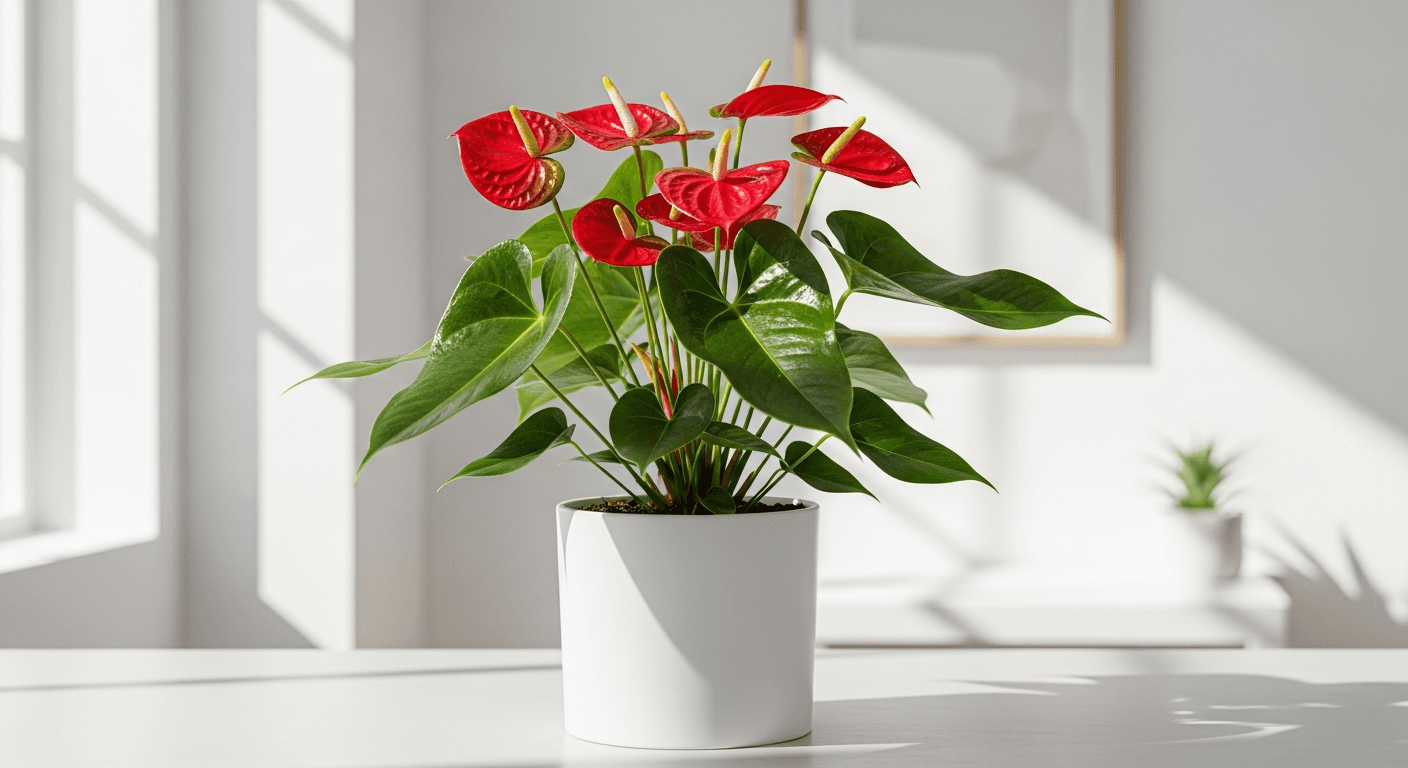
Let me geek out for a second, because this is genuinely useful for care. What we call the flower is the spathe, a waxy modified leaf (a bract). The true flowers are tiny and packed onto the spadix, the tail-like spike sticking up from the center. Watch the spadix closely and you'll often see a faint band of pollen migrate up it over a week or two — those are real flowers doing real flower things.
Anthuriums belong to the arum family, Araceae, the same clan as the peace lily, the monstera, the philodendron and the dieffenbachia. That family membership tells you almost everything: they like warmth, they like humidity, they resent soggy roots, and every part of them carries calcium oxalate crystals (more on that at the end). The common houseplant is usually Anthurium andraeanum (the one with stiff, heart-shaped, mirror-shiny spathes) or Anthurium scherzerianum (softer leaves, a curly orange spadix). There are also leaf-only collector species like A. clarinervium and A. crystallinum grown purely for their velvety, silver-veined foliage — same care philosophy, even more humidity.
Is your plant looking off and you are not sure why?
Free AI diagnosisBasic care, point by point
Light: the single biggest lever for blooming
If your anthurium has lovely leaves but hasn't pushed a spathe in months, this is almost always the reason.
In the wild these grow as epiphytes and hemi-epiphytes in the dappled understory, catching bright light filtered through a canopy. Indoors that translates to bright, indirect light: an east window, a few feet back from a south or west window, or right against a north window if it's unobstructed. That filtered-canopy quality is exactly what an east-facing sill or a sheer-curtained window delivers — if you want the full breakdown, see indoor plant light.
- Ideal: bright, indirect light for most of the day. This is what powers continuous spathe production.
- Tolerated: medium light. The plant stays alive and green but slows or stops blooming.
- Avoid: harsh direct midday sun, which scorches and bleaches the leaves and fades the spathes to a washed-out pink.
A rough field test: hold your hand a foot above the plant at midday. A soft, fuzzy shadow means good indirect light. No shadow at all means it's too dark to bloom. A hard, sharp shadow means the sun is too direct and you risk burn. If you only have a dim corner, a basic LED grow light on for 10–12 hours a day will absolutely get an anthurium blooming again.
Watering: steady moisture, never soggy
Anthuriums want their mix to stay lightly, evenly moist — not bone dry, not swampy. The thick white roots are adapted to grip bark and breathe air, so they rot fast if they sit in water, but they also dislike drying out completely.
The reliable method is to water when the top inch (about 2–3 cm) of the mix feels dry to your finger, then water thoroughly until it runs out the drainage holes.
- Spring and summer: roughly every 5–7 days, depending on warmth and light.
- Fall and winter: stretch it out, often to every 10–14 days as growth slows.
- Use room-temperature water that's low in lime. Anthuriums are sensitive to salts and minerals; collected rainwater, distilled, or filtered water keeps the leaf tips clean.
Always empty the saucer or cachepot within 30 minutes of watering. Roots left standing in water are the number one killer of anthuriums.
That overwatering risk is worth taking seriously — soggy roots quietly turn to mush long before the leaves complain. If you ever knock one out of its pot and find brown, hollow, smelly roots instead of firm white ones, you're dealing with root rot, and the rescue is to cut away the dead roots, refresh the mix, and water far more sparingly while it recovers.
Humidity and temperature
This is a tropical, and humidity is not optional if you want it to thrive rather than merely survive. Aim for 60% or higher; below about 50% you'll start seeing crispy brown edges and tips, and the velvet-leaf species sulk badly. To raise it:
- Group plants together so they share transpired moisture, or run a small humidifier nearby — the most reliable fix by far.
- Set the pot on a pebble tray: a saucer of gravel with water added to just below the top of the stones, so the pot sits above the water line rather than in it.
- Keep it away from heating vents, radiators and air-conditioning blasts, which crater the local humidity.
A full rundown of methods that actually move the needle (and the ones that don't, like daily misting) lives in humidity for plants.
Temperature-wise, keep it between 65 and 82 °F (18–28 °C). It will tolerate a touch warmer with enough humidity, but never let it drop below 55 °F (13 °C) — cold is what triggers blackened, stalled growth. Keep it clear of cold drafts and don't let leaves press against a freezing winter windowpane.
Soil and repotting
The anthurium is semi-epiphytic, so the mix needs to drain freely and stay airy — roots that can breathe are happy roots. Standard bagged potting soil packs down and suffocates them. Build something chunky instead:
A blend that works beautifully is roughly:
- 40% orchid bark (the structural backbone that keeps air pockets open)
- 20% perlite or pumice for drainage
- 20% coco coir or peat to hold a little moisture
- 20% standard houseplant potting mix for a touch of nutrition
If you'd rather not mix your own, a bagged orchid or aroid mix gets you most of the way there. For the reasoning behind chunky, airy blends versus dense compost, see potting soil.
Repot every 2 years, or sooner if roots are spiralling out the drainage holes or the plant climbs out of its pot. Go up just one pot size — anthuriums actually flower better when slightly snug, and an oversized pot holds too much wet mix around the roots. Spring is the ideal time. When you repot, you can often divide a crowded plant: tease apart a clump that has its own roots and pot it separately for a free new plant.
The secret to nonstop blooming
Reblooming an anthurium isn't luck. It's a stack of conditions, and getting four to six spathes a year out of a healthy plant is entirely normal once they line up:
- Bright, indirect light every day, all year. This is non-negotiable — see the light section above.
- Feed during active growth. A balanced or slightly phosphorus-leaning houseplant fertilizer, diluted to half strength, every 2–4 weeks in spring and summer. Phosphorus (the middle number) supports flowering, but don't overdo nitrogen or you'll get all leaves and no spathes. Skip feeding in winter.
- Deadhead spent spathes. When a spathe fades to green and tips over, cut its stem off at the base with clean scissors. This redirects energy into the next bloom.
- Keep humidity high and watering even. A stressed, dried-out plant pauses flowering to protect itself.
- Don't repot too often or pot up too big. A slightly root-bound anthurium blooms more freely than one swimming in fresh mix.
Give it those five things consistently and the plant rewards you with a near-continuous parade of spathes, each one lasting six to eight weeks on the plant.
Troubleshooting common problems
Most anthurium complaints trace back to just a few causes. Here's the quick-reference version:
| Symptom | Most likely cause | Fix |
|---|---|---|
| Healthy leaves but won't bloom | Too little light (or too much nitrogen) | Move to bright, indirect light; switch to a phosphorus-leaning feed |
| Brown, crispy leaf tips and edges | Low humidity or hard / salty water | Raise humidity above 60%; water with filtered or rainwater |
| Yellowing lower leaves | Overwatering / soggy mix | Let the top inch dry out; check roots are firm and white |
| Spathes come out small or greenish | Too little light, or the spathe is simply aging | Increase light; deadhead old spathes |
| Spathes fade or bleach | Direct sun exposure | Move out of harsh midday rays |
| Wilting despite moist soil | Root rot from waterlogging | Unpot, trim mushy roots, repot in airy mix, water sparingly |
| Stalled, blackened new growth | Cold exposure | Move somewhere warmer, away from drafts and cold glass |
Pests are less common but do happen indoors, especially when the air is dry. Watch for fine webbing and stippled, dusty-looking leaves — that's spider mites, which boom in low humidity, so raising humidity both prevents them and makes the plant happier overall. Mealybugs and scale can also tuck into leaf joints; wipe them off with a cotton swab dipped in diluted rubbing alcohol.
If you're staring at a sad anthurium and genuinely can't tell whether it's water, light, or a pest, snap a clear photo and run it through the AI diagnosis tool — it'll help you narrow down the most likely culprit before you start changing things.
How it compares to its relatives
If you already grow other aroids and bromeliads, here's where the anthurium sits relative to the usual suspects. It's a useful mental map for deciding where to put it on a shelf.
| Plant | Light | Humidity need | Forgiveness |
|---|---|---|---|
| Anthurium | Bright, indirect | High (60%+) | Medium |
| Peace lily | Low to medium | Medium | High |
| Monstera | Bright, indirect | Medium | High |
| Orchid | Bright, indirect | Medium–high | Medium |
| Bromeliad | Bright, indirect | Medium | High |
The takeaway: an anthurium is thirstier for humidity and a touch less forgiving than a peace lily or monstera, but it's not difficult once it has bright light and damp (not wet) roots. Treat it more like an orchid that happens to live in a pot of bark, and you'll be on the right track.
Is it toxic?
Yes. Like all aroids, the anthurium contains insoluble calcium oxalate crystals throughout its tissues. If a pet or child chews on a leaf or spathe, those crystals cause intense burning and irritation of the mouth, lips and throat, drooling, and sometimes swelling or vomiting. It is rarely life-threatening but genuinely unpleasant, so keep it out of reach of curious cats, dogs and toddlers, and wash your hands after pruning if your skin is sensitive to the sap.
Give an anthurium bright indirect light, humidity above 60%, an airy bark-based mix and watering that keeps it evenly moist but never soggy, and it'll reward you with those glossy, almost artificial-looking spathes for the better part of the year. It looks exotic, but it's really just asking you to recreate a shady, humid spot under a tropical tree — and that's a fun puzzle to solve.
Related articles
Hibiscus in Pots: Care for Spectacular Blooms
Hibiscus (Hibiscus rosa-sinensis) care in pots: full sun, watering and feeding for big blooms, pruning, and how to overwinter it indoors. Full guide.
Bromeliad Care: Watering the Central Cup and Pups
Bromeliad care: watering the central cup, bright indirect light, humidity and what to do with the pups when the plant flowers and dies. Full guide.
Begonia Care: Rex and Maculata (Polka Dot) Begonias
Begonia rex and maculata care: bright indirect light, watering without wetting the leaves, humidity, propagation and why it's toxic to pets. Full guide.
Trouble with your plant?
AI diagnosis