Areca Palm: Brown Tips and How to Prevent Them
Care for the areca palm indoors: bright indirect light, watering, humidity, why the tips go brown, and why it's pet-safe and one of the best air-purifying plants.
In this article
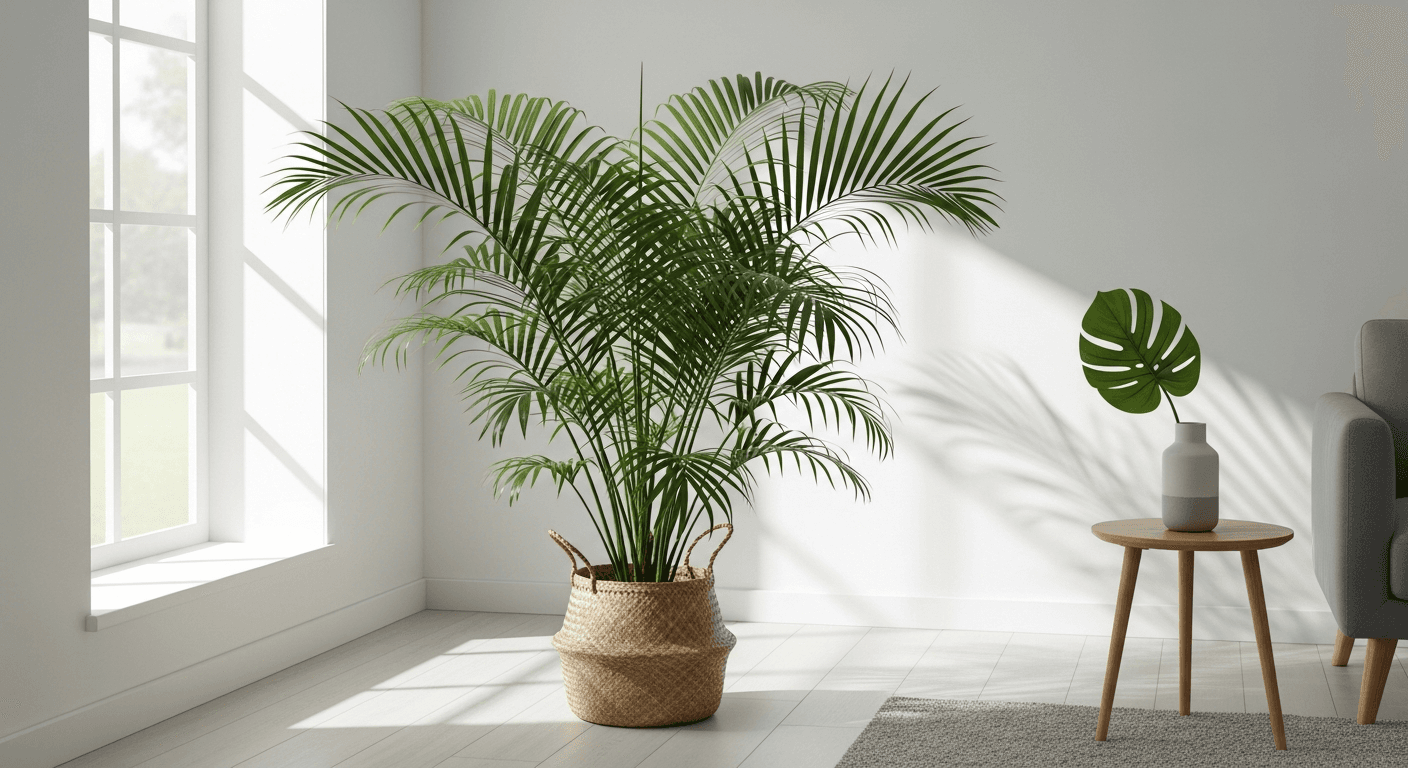
The areca palm (Dypsis lutescens) is the houseplant world's shortcut to a tropical living room: a cluster of bamboo-like stems topped with feathery, arching fronds that catch the light beautifully. It is genuinely pet-safe, it is one of the most efficient leafy plants for moving air around a room, and — full disclosure from someone who grows it — it has a deserved reputation for browning its leaf tips if you ignore it. The good news is that "fussy" really comes down to three levers: light, water chemistry, and humidity. Get those dialed in and an areca stays full and green for years. Here is the why behind every step, plus the troubleshooting I wish I'd had when I started.
Where it actually comes from (and why that matters)
This palm is endemic to Madagascar, where in the wild it is so rare it is considered endangered — yet it is one of the most mass-produced ornamentals on Earth. In its native habitat it grows as an understory and forest-edge clumper, soaking up filtered light, warm humid air, and the steady moisture of a tropical climate. Almost every care "rule" below is just an attempt to recreate that: bright but shaded light, water that never quite dries out completely, and air that does not feel like a desert. When your areca sulks, it is usually telling you that one of those three conditions has drifted.
Plants sold as "areca palm" are nearly always Dypsis lutescens. You may also see the names golden cane palm, butterfly palm, or the old botanical name Chrysalidocarpus lutescens — all the same species.
Is your plant looking off and you are not sure why?
Free AI diagnosisLight
- Ideal: bright, indirect light right beside a well-lit window. An east-facing window is close to perfect.
- Tolerates: a couple of hours of soft, early-morning sun.
- Avoid: harsh midday and afternoon sun through glass, which bleaches the fronds to a pale yellow-green and scorches the tips.
An areca in too much shade does not die quickly, but it grows slow, stretches toward the window, and goes leggy with wide gaps between fronds. South- and west-facing rooms work well if you set the palm a few feet back from the glass or filter the light with a sheer curtain. Because the canopy reaches for the brightest source, rotate the pot a quarter-turn every couple of weeks so it fills out evenly instead of leaning. If your room is genuinely dim, a basic grow light on a timer for 10-12 hours a day keeps it compact — the same principle behind fixing leggy, stretched-out plants.
Watering
This is the make-or-break part, and it trips up more areca owners than anything else. The target is soil that stays evenly moist but never waterlogged — think of a wrung-out sponge.
- Water when the top inch (about 2.5 cm) of the mix feels dry. In a bright, warm spot that is often once or twice a week in summer.
- In winter, growth slows and the soil dries more slowly; let the top 2 inches dry and water roughly every 10-14 days.
- When you water, water thoroughly — let it run out of the drainage holes — then empty the saucer after 10-15 minutes. Sitting water is how roots rot.
- Never let the pot stand permanently in a tray of water.
The fastest way to read the plant is to lift the pot: a freshly watered areca is noticeably heavy, a thirsty one feels light. If you are second-guessing yourself, a cheap moisture meter pushed two-thirds of the way down removes the drama. The two failure modes pull in opposite directions, so it helps to know the tells — overwatering shows up as soft yellow fronds and a sour-smelling, soggy mix, while underwatering shows up as crispy brown tips and a rootball that has pulled away from the pot. I break the difference down further in this guide to overwatering versus underwatering.
Water quality
Arecas are unusually sensitive to fluoride, chlorine, and dissolved salts, which accumulate in the leaf margins and burn the tips brown. This is one of the few houseplants where the type of water genuinely matters. If your tap water is hard or fluoridated, switch to filtered water, distilled water, or collected rainwater. A no-cost workaround: fill a watering can and let it sit uncovered overnight so some of the chlorine off-gasses before you use it. (It does not remove fluoride, but it helps with chlorine.)
Humidity: the real key
Coming from Madagascar, the areca is happiest above 50% relative humidity and starts protesting below 40%. In winter, central heating can drag indoor air down to 20-30% — drier than many deserts — and that is exactly when those crispy brown tips appear. To keep the air around it tropical:
- Group it with other plants. A cluster of foliage creates its own humid micro-zone through shared transpiration.
- Run a humidifier nearby during the heating season — by far the most reliable fix.
- Use a pebble tray: a shallow dish of water with stones under (not touching) the pot raises local humidity as it evaporates.
- Mist occasionally if you enjoy it, but be honest with yourself — misting bumps humidity for only 15-20 minutes, so it is a supplement, not the solution.
For the full method, including how to actually measure room humidity, read our humidity for houseplants guide.
Soil and repotting
Use a loose, fast-draining mix that still holds some moisture: a quality all-purpose potting soil cut with about 20-30% perlite, plus a handful of coco coir or fine bark, hits the sweet spot. The drainage matters as much as the ingredients — a heavy, dense mix in a pot without holes is a one-way ticket to root rot.
The areca likes its roots a little crowded, and a snug pot actually reduces the risk of overwatering, so resist the urge to size up too soon. Repot only every 2-3 years, in spring, and go just one pot size larger (an inch or two of extra diameter). Be gentle with the rootball — arecas resent heavy root disturbance and may pause for a few weeks while they settle. If yours looks off after repotting, that is normal transplant shock, not a watering problem; hold steady and don't overcorrect.
Temperature
Keep it in the 65-80 °F (18-27 °C) range it evolved for. Avoid:
- Cold drafts from doors, drafty windows, and air-conditioning vents.
- Hot, dry air blowing directly from a heating vent or radiator.
- Anything below 55 °F (13 °C) — at that point growth stalls and cold damage can set in. It is not frost-hardy and should never go outside in a cold snap.
A sudden chill or a draft will often brown the fronds on just the exposed side, which is a handy diagnostic clue.
Feeding
During the growing season — roughly spring through early autumn — feed every 4-6 weeks with a balanced liquid fertilizer diluted to half the labeled strength. Because the areca is salt-sensitive, little and often beats one big dose, and over-feeding is a classic cause of brown tips and a white salt crust on the soil surface. If you see that crust, flush the pot: run water through the soil several times to leach the salts out, then let it drain fully. Stop feeding entirely in late autumn and winter, when the plant is barely growing and cannot use the nutrients.
Light, water, and humidity at a glance
| Need | Sweet spot | Warning sign you missed it |
|---|---|---|
| Light | Bright, indirect; gentle morning sun | Leggy and pale (too little) / bleached, scorched (too much) |
| Water | Top inch dry, then water thoroughly | Soggy + yellow (too much) / crispy + light pot (too little) |
| Water quality | Filtered, distilled, or rainwater | Brown leaf tips and margins |
| Humidity | Above 50% | Crispy brown tips, worst in winter |
| Temperature | 65-80 °F (18-27 °C) | Browning on the draft-exposed side |
| Feeding | Half-strength, every 4-6 weeks (spring-summer) | White salt crust, burned tips |
Why the tips turn brown
This is the areca's signature complaint, and it almost always traces back to one of four causes. Here is how to tell them apart and fix each.
| Likely cause | Tell-tale sign | The fix |
|---|---|---|
| Dry air | Worst in winter, many fronds tipped brown at once | Humidifier or pebble tray; aim for 50%+ |
| Hard or fluoridated water | Browning at the very tips and along the margins | Switch to filtered, distilled, or rainwater |
| Erratic watering | Mix swings bone-dry then soaked | Settle into a consistent top-inch-dry routine |
| Fertilizer salt build-up | White crust on soil, browning after feeding | Flush the pot; feed at half strength |
When you trim, cut only the dead brown part, following the frond's natural pointed shape, and leave a thin sliver of brown rather than slicing into green tissue — cutting into living leaf just creates a fresh brown edge. Use clean, sharp scissors. And take comfort that a few browning lower fronds is simply the plant retiring its oldest leaves; remove those at the base.
It cleans and purifies the air
The areca is safe for dogs, cats, and curious toddlers — no toxic compounds, no oxalate crystals — which already sets it apart from many glossy houseplants. It also earned a spot among the better foliage plants for improving indoor air, thanks to a large, actively transpiring canopy that moves humidity and filters airborne compounds. A realistic note from a grower: the famous lab studies on plants and air were done in sealed chambers, so don't expect one palm to scrub an entire living room — but a healthy areca genuinely lifts local humidity and looks the part.
To keep all that surface area working, wipe the fronds with a damp cloth every few weeks. Dust blocks light and clogs the pores the plant breathes through; clean fronds photosynthesize better and look far nicer. Our guide to cleaning plant leaves covers the gentle way to do it on feathery foliage like this.
Pests to watch for
Indoors, the areca's main enemy is the spider mite, and dry winter air is exactly what they love. Watch for fine stippling or speckling on the fronds, a faint webbing in the leaf joints, and an overall dull, dusty look. Because dry air invites both mites and brown tips, the same fix — raising humidity — works against both. If you spot them, rinse the foliage, raise the humidity, and treat with insecticidal soap or neem; here is the full spider mite battle plan. Less commonly you may see mealybugs or scale, which look like white cottony tufts or small brown bumps along the stems.
Loving the look but want something easier?
If the humidity demands feel like a lot, two relatives ask for less. The parlor palm gives a similar feathery, tropical vibe but tolerates lower light and drier air far more forgivingly, while the ponytail palm — not a true palm at all — stores water in its swollen base and practically thrives on neglect. Either makes a great stepping stone before you graduate to fussier tropicals.
Still not sure whether watering, humidity, water quality, or a pest is behind your areca's sulk? Snap a photo and upload it to our AI diagnosis tool — it will help you narrow down the cause before you start changing things.
Related articles
Coffee Plant Care: Growing Coffea at Home
Coffee plant (Coffea arabica) care as a houseplant: bright indirect light, humidity, watering, and whether you can really harvest your own coffee beans.
Norfolk Island Pine Care: The Living Christmas Tree
Norfolk Island pine (Araucaria heterophylla) care: light, watering, humidity and why its branches turn brown and drop. The living indoor Christmas tree guide.
Aglaonema (Chinese Evergreen): The Complete Care Guide
Care guide for the Aglaonema or Chinese evergreen: light for the pink varieties, watering, humidity, propagation by division and its toxicity to pets.
Trouble with your plant?
AI diagnosis