Aglaonema: Colour for Corners Where Others Fail
Care guide for the Aglaonema or Chinese evergreen: light for the pink varieties, watering, humidity, propagation by division and its toxicity to pets.
In this article
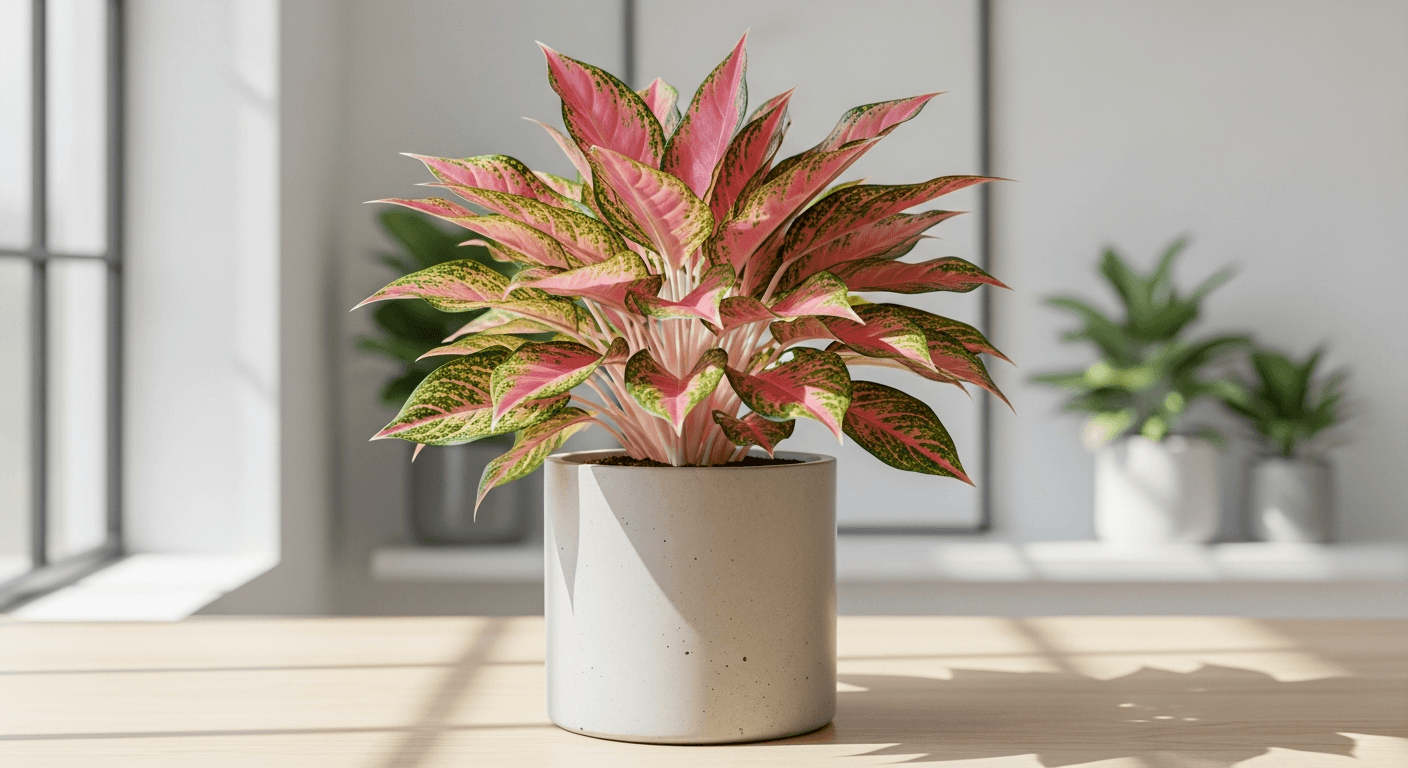
The Aglaonema, better known as the Chinese evergreen, is one of the most forgiving houseplants you can own. Its broad, mottled leaves — in silvery green or striking shades of pink and red — put up with conditions that would make other plants sulk. If you want real color without the fuss, this is your plant. The catch most guides skip is that "Aglaonema" covers dozens of cultivars with very different needs: the tough green ones genuinely thrive in a dim corner, while the pink and red showstoppers will quietly fade if you treat them the same way. Once you match the variety to the light you actually have, this plant practically takes care of itself.
I learned the value of reading a plant early through trial and error, and the Aglaonema is one of the kindest plants to learn troubleshooting on. It tells you what is wrong slowly and clearly — a yellowing lower leaf here, a brown tip there — which gives you time to react before anything is lost. This guide walks through everything from picking the right cultivar to fixing the handful of problems that actually crop up.
Quick-care snapshot
| Factor | What it needs |
|---|---|
| Light | Low to medium for green varieties; bright indirect for pink and red |
| Watering | When the top 1–1.5 in (2.5–4 cm) of soil dry out |
| Humidity | Medium to high (45–60%); tolerates average rooms |
| Temperature | 65–80 °F (18–27 °C); never below 60 °F (16 °C) |
| Soil | Airy, well-draining mix with perlite |
| Feeding | Diluted balanced fertilizer, spring through early autumn |
| Difficulty | Easy |
| Toxicity | Toxic to pets and children (calcium oxalates) |
Is your plant looking off and you are not sure why?
Free AI diagnosisOrigin and why it forgives so much
The Aglaonema comes from the tropical forests of Southeast Asia, where it grows close to the ground beneath a dense canopy of taller trees. Very little direct sun ever reaches it. That shady, humid, consistently warm forest floor is the key to its whole personality: it is built to make the most of dim, filtered light, it likes steady moisture without ever sitting in water, and it has no tolerance for cold. Picture those conditions whenever you are unsure what your plant wants, and the right answer is usually obvious.
That heritage also explains its slow, tidy growth. An Aglaonema will not vine across your shelf like a pothos or unfurl a giant new leaf every few weeks. It builds gradually into a full, bushy clump, which is exactly why it stays handsome on a desk or side table for years.
Choosing a variety (this decides everything)
There are dozens of cultivars, and the single most useful thing to know is that leaf color predicts light needs. The more white, silver, pink, or red on a leaf, the less chlorophyll it has — and the more light it needs to power itself.
- Deep green and silver-green types ('Silver Queen', 'Maria', 'Emerald Beauty') are the toughest and the true low-light champions. These are the ones that genuinely cope with a north-facing room or an interior corner.
- Pink and red types ('Red Siam', 'Pink Dalmatian', 'Siam Aurora', 'Sparkling Sarah') are the showy ones, and they need bright indirect light to hold that color. Starve them of light and the pink retreats, the leaves go greener, and new growth comes in plain.
If all you can offer is a dark corner, buy a green cultivar and you will be delighted. If you fell for a pink one, give it the brightest indirect spot you have. For more on placement, our guide to low-light plants explains how to judge a room honestly, and understanding indoor plant light covers the difference between "bright" and "direct."
Basic care, point by point
Light
- Green and silver varieties: tolerate shade and genuine low light. A spot a few feet back from a north or east window, or under good ambient room light, is plenty.
- Pink and red varieties: need bright indirect light all day to keep their color. An east window, or a couple of feet back from a south or west window behind a sheer curtain, is ideal.
- Avoid direct midday sun. Harsh rays scorch the leaves, leaving pale bleached patches or crispy brown sections that never recover.
The most common light complaint is a colorful Aglaonema slowly losing its intensity. That is almost always a request for more light, not less. Move it brighter (still indirect) and new leaves will come in more vivid over the following months — the existing faded leaves will not re-color, but the plant grows out of it.
Watering
Water when the top 1–1.5 inches (2.5–4 cm) of soil are dry — check with your finger rather than a calendar. In practice that tends to be roughly once a week in summer and every 10–14 days in winter, but light, pot size, and your home all shift that number, so test before you pour.
When you do water, water thoroughly: soak until it runs from the drainage holes, then empty the saucer so the roots are never standing in water. The Aglaonema would much rather be a touch too dry than soggy, and overwatering is the number-one way people kill it. If you are ever unsure which way your plant is leaning, our breakdown of overwatering versus underwatering shows how to tell them apart, because the symptoms overlap.
Rule of thumb: when in doubt, wait one more day. A thirsty Aglaonema recovers in hours; a waterlogged one can lose its roots.
A quick note on water quality: Aglaonemas are mildly sensitive to the fluoride, chlorine, and salts in hard tap water, which is one cause of those brown leaf tips. If your tap is hard, let water sit out overnight, or use filtered or rainwater.
Humidity and temperature
Being a forest-floor tropical, the Aglaonema appreciates medium-to-high humidity (aim for 45–60%), but it is far more tolerant of average indoor air than divas like the calathea. In very dry, heated rooms you may see brown tips creeping in; that is your cue to raise humidity. Grouping plants together, setting the pot on a tray of pebbles and water (pot above the waterline, not in it), or running a small humidifier all work well. Our guide to humidity for plants compares these methods in detail.
Temperature is where this plant is genuinely fussy. It is cold-sensitive: keep it between 65–80 °F (18–27 °C), and never let it drop below 60 °F (16 °C). Below about 59 °F (15 °C) the leaves can develop greasy dark blotches or turn black at the edges — chilling injury that does not heal. The usual winter culprits are a spot pressed against a cold windowpane, a doorway with a draft, or an air-conditioning vent blowing straight on it. Our winter plant care guide covers moving tender plants safely through the cold months.
Soil and repotting
Use an airy, well-draining mix. A quality general potting soil loosened with a generous handful of perlite (and optionally a little orchid bark) gives the roots the oxygen they want while still holding some moisture. Our potting soil guide explains how to build or choose a mix like this.
The Aglaonema grows slowly and actually prefers to be a little snug in its pot, so you only need to repot every 2–3 years, when you see roots circling the surface or poking from the drainage holes. When you do, step up just one size — about 2 inches (5 cm) wider — because a pot that is too big holds excess wet soil around the roots and invites rot. Spring or early summer is the best time, so the plant can settle into active growth.
Always use a pot with drainage holes. If you love a decorative cachepot without holes, keep the plant in a plain nursery pot inside it and lift it out to water. Our guide to choosing the right pot walks through material and size trade-offs.
Feeding
Light feeders by nature, Aglaonemas need only modest fertilizer. From spring through early autumn, feed with a balanced houseplant fertilizer diluted to half strength roughly once a month. Stop feeding in late autumn and winter when growth naturally slows — pushing fertilizer on a dormant plant just builds up salts in the soil, which shows up as, you guessed it, brown leaf tips. If you suspect salt buildup, flush the pot by running water through it generously a few times every few months.
Propagation
The easiest and most reliable method is division, done at repotting time:
- Slide the whole plant out of its pot and gently brush soil away from the base.
- Look for natural offsets — stems with their own cluster of roots growing from the parent.
- Tease or cut these apart so each division keeps a healthy section of roots and at least a few leaves.
- Pot each one in fresh mix, water lightly, and keep it warm and out of direct sun while it settles.
You can also root stem cuttings: cut a length of stem with a couple of leaf nodes, place it in water or damp soil, keep it warm and bright-indirect, and wait. Cuttings are slower and less guaranteed than division — expect several weeks before roots appear in water — but they are a good way to use the trimmings from a leggy plant. Change the water every few days if you root in water.
Troubleshooting common problems
The Aglaonema's symptoms are readable once you know the pattern. Use this table to match what you see to the likely cause.
| Symptom | Likely cause | Fix |
|---|---|---|
| Brown, crispy tips and edges | Dry air, or salts/minerals in hard water | Raise humidity; switch to filtered or rainwater; flush the soil |
| Yellowing lower leaves | Overwatering or poor drainage | Let soil dry more; check the pot drains; consider repotting |
| Greasy dark or black blotches | Cold damage or a draft | Move somewhere warmer, away from windows and vents |
| Faded or reverted color | Not enough light (pink/red types) | Move to brighter indirect light |
| Pale, bleached patches | Direct sun scorch | Move out of direct rays |
| Drooping despite moist soil | Roots stressed by rot or cold | Check roots; ease off water; warm it up |
| Slow or no new growth in summer | Too dark, underfed, or rootbound | Brighter spot, light feeding, or repot |
A few notes that the table cannot capture: occasional yellowing of the oldest, lowest leaf is normal aging — the plant shedding a tired leaf — and nothing to worry about. It is widespread, sudden yellowing that signals overwatering, and that often traces back to root rot, so check the roots if the soil stays wet and the plant looks generally unhappy.
Pests are uncommon on a healthy Aglaonema, but watch for the usual indoor suspects: cottony white tufts in the leaf joints point to mealybugs, and fine webbing with stippled leaves means spider mites, which appear when the air is very dry. Wiping the leaves now and then (see cleaning leaves) both keeps them glossy and lets you catch pests early.
When something looks off and you genuinely cannot tell which cause you are dealing with — the symptoms for cold damage and overwatering, for instance, can look alike — upload a clear photo to our AI diagnosis tool to narrow it down before you act. Acting on the wrong theory (watering a plant that is actually too wet) is how a fixable problem becomes a fatal one.
Is it toxic?
Yes. Like its relative the Dieffenbachia, the Aglaonema contains insoluble calcium oxalate crystals throughout its leaves and stems. If a pet or child chews it, those crystals cause intense burning and irritation of the mouth, lips, and throat, along with drooling, swelling, and difficulty swallowing. It is rarely life-threatening but genuinely painful, so keep the plant well out of reach of curious cats, dogs, and toddlers, and wash your hands after taking cuttings — the sap can irritate sensitive skin too.
The short version
Match the variety to your light — green for shade, pink and red for bright indirect — water only when the top inch or two dries out, keep it warm and away from cold drafts, and feed it lightly in the growing season. Do that and the Aglaonema rewards you with rich, patterned foliage and almost no drama for years. It is, quite honestly, the plant I recommend most often to anyone who says they kill everything.
Related articles
Parlor Palm (Chamaedorea): Care and Why It's Ideal
Parlor palm (Chamaedorea) care: tolerates low light, watering, humidity, why the fronds brown at the tips, and why it's safe for pets. Full guide.
Coffee Plant Care: Growing Coffea at Home
Coffee plant (Coffea arabica) care as a houseplant: bright indirect light, humidity, watering, and whether you can really harvest your own coffee beans.
Norfolk Island Pine Care: The Living Christmas Tree
Norfolk Island pine (Araucaria heterophylla) care: light, watering, humidity and why its branches turn brown and drop. The living indoor Christmas tree guide.
Trouble with your plant?
AI diagnosis