Which Plants Genuinely Cope With a Sunless Corner
Got a dark flat or a room with no sun? These plants thrive in low light. A list with their care and the tricks to keep them alive where others die.
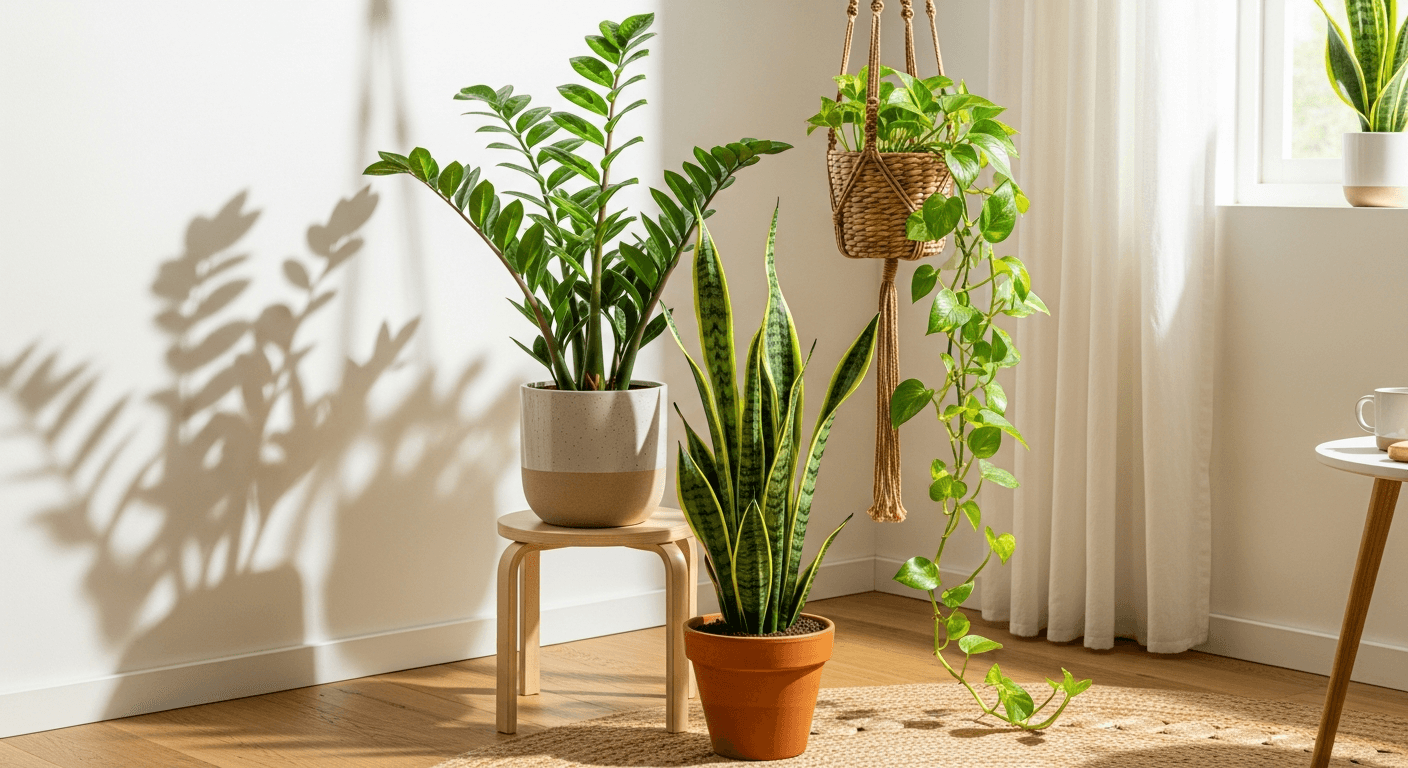
In this article
Not all of us have a home full of south-facing windows. North-facing flats, ground floors hemmed in by buildings, hallways, that one bathroom with a tiny frosted pane — they all read as "dark" to a plant. The good news: a handful of houseplants evolved on the dim forest floor, under a canopy of taller trees, and they genuinely cope with low light. I learned this the slow way, by killing a fiddle-leaf fig in a corner that turned out to get almost no usable light. Pick the right plant and water it correctly, and even a shady room can stay green.
This guide covers which plants actually tolerate shade, how to tell whether your spot is "low light" or simply too dark, and the small habit changes that keep shade plants alive where others rot or stretch.
The low-light champions
These are the plants I reach for first when someone tells me their room "gets no sun." None of them need direct light, and all of them forgive the odd missed watering — which matters, because slow-growing plants in dim rooms are easy to overwater.
| Plant | Why it copes | Watch out for |
|---|---|---|
| ZZ plant | Thick rhizomes store water; near-indestructible | Yellow stems = overwatering |
| Snake plant | Succulent leaves, very low water needs | Mushy base from soggy soil |
| Pothos | Vining and adaptable; tells you when thirsty | Variegation fades in deep shade |
| Peace lily | One of the few that blooms in low light | Dramatic droop when dry |
| Aglaonema | Tolerant; pink types want a touch more light | Cold draughts cause leaf spots |
| Parlor palm | Classic Victorian shade palm; pet-safe | Brown frond tips from dry air |
| Dracaena | Upright, elegant, shade-tolerant | Sensitive to fluoride in tap water |
| Fern (Boston, bird's nest) | Used to dappled forest-floor light | Crisps fast if humidity is low |
A few notes on this list. The ZZ plant and snake plant are the toughest; if you forget plants exist for weeks at a time, start there. Pothos is the best "communicator" — its leaves go soft and limp when it wants water and perk back up within hours, so it teaches you its rhythm quickly. The peace lily is the one to choose if you want flowers in a dim room; nothing else on this list blooms reliably in shade. And the green-leaved varieties always handle low light better than the variegated or pink ones, because white and pink sections of a leaf have less chlorophyll and need more light to pay their way.
Is your plant looking off and you are not sure why?
Free AI diagnosisWhat "low light" actually means (and doesn't)
This is where most people go wrong, so it's worth being precise. Low light is not darkness. No plant on earth lives without light — photosynthesis is how they eat, and a pitch-dark corner is a slow starvation chamber. "Low light" describes a spot that is bright enough to function in, just without direct sun hitting the plant.
In practical terms, low light usually means:
- 6 to 10 feet (2 to 3 m) back from a window, out of any direct beam.
- A north-facing window (in the Northern Hemisphere — flip it south of the equator), which gets steady, soft light but no direct sun.
- A bright room with the sun blocked by a sheer curtain, a neighbouring building, or an overhang.
Here is the test I give everyone: at midday, can you read a paperback there comfortably without switching on a lamp? If yes, it's low light and these plants will manage. If you need the lamp on, it's too dark even for a ZZ plant, and your real options are to move the plant nearer the window or add an LED grow light. For the full picture on reading a room's brightness — including the simple shadow test — see my guide to indoor plant light.
One more thing people miss: artificial light counts, a little. A room lit for many hours a day by bright overhead LEDs is meaningfully better than the same room left dark. It is not a substitute for a window, but in an office or a hallway it nudges a tolerant plant from "declining" to "holding steady." That is why so many of these same species turn up on my list of office plants.
How to care for plants in low light
Shade plants do not need different care so much as recalibrated care. The single biggest mental shift is this: a plant in low light grows slowly, so it drinks slowly, eats slowly, and is far more easily overwatered than the same plant in a bright window.
Water far less than you think
In a dim room the soil stays wet for days longer because there's little light driving evaporation and little growth using the water. If you water a low-light pothos on the same Sunday schedule as a bright-window one, you will drown it.
- Always check first. Push a finger 2 inches (5 cm) into the soil. If it feels cool and damp, wait. For most of these plants, water only when the top third of the pot has dried out — for snake plants and ZZ plants, let it go nearly bone dry.
- Empty the saucer 15 minutes after watering. Roots sitting in standing water is the express route to rot.
- Stretch the calendar in winter, when light drops further and growth almost stops. I sometimes go three to four weeks between waterings for a snake plant in a north room in January.
Overwatering in low light is, by a wide margin, the most common way these plants die. The warning signs — yellowing lower leaves, a soft or mushy base, a sour smell from the soil, fungus gnats — all point the same direction. If you spot them, read up on root rot fast, because once it takes hold it moves quickly.
Let every ray earn its keep
When light is scarce, you want the plant catching all of it.
- Clean the leaves. A film of dust can noticeably cut the light a leaf receives. Wipe broad-leaved plants (peace lily, dracaena, aglaonema) with a damp cloth every few weeks — here's how to clean leaves without damaging them.
- Rotate the pot a quarter turn each time you water, so the plant grows evenly instead of leaning hard toward the brightest side.
- Use a "recovery" rotation for your dimmest spots. Keep a second plant of the same type and swap them every few weeks — one rests in the dark corner while the other recharges near a window. It is the simplest way to keep a truly gloomy nook green without anything slowly fading.
Ease off the fertiliser
A slow-growing plant can't use much food, and unused fertiliser salts build up in the soil and burn roots. Feed low-light plants at half the normal strength and half the normal frequency — roughly once a month during spring and summer, and not at all from late autumn through winter while growth is paused.
Common mistakes and how to troubleshoot
Most low-light failures trace back to four or five issues. Here is the quick diagnostic I run through:
| Symptom | Most likely cause | What to do |
|---|---|---|
| Long, thin stems; big gaps between leaves; plant leaning hard to the window | Too little light (etiolation) | Move closer to light or add a grow light; pinch back the leggy growth |
| Yellow lower leaves, soft mushy base, soil stays wet for days | Overwatering / root rot | Stop watering, check roots, repot into fresh dry mix if rot is present |
| New leaves smaller and paler than old ones; variegation turning solid green | Not enough light to sustain new growth | Brighter spot; choose a green-leaved variety for that corner |
| Crispy brown leaf edges or tips | Dry air, not low light | Group plants, add a pebble tray or humidifier (ferns especially) |
| Leggy and pale together | Classic "starving for light" | This corner is too dark — relocate or supplement with an LED |
The mistake I see most often is blaming the wrong thing. People assume a stretched, sad plant needs more water and more food, when in fact it needs more light — adding water to a light-starved plant in a dark corner just rots it. When growth goes leggy and pale, light is almost always the culprit, not your watering can.
The second trap is expecting too much from a tolerant plant. "Tolerates low light" means survives, not thrives. A pothos in a dark hallway won't die, but it also won't put out lush, fast new vines the way it would near a bright window. If you want vigorous growth or flowers, you have to provide more light — there is no plant that grows fast in the dark.
When to give up and add a grow light
If you have tried a snake plant or ZZ plant in your spot and even they slowly decline — losing leaves, never pushing new growth, leaning desperately toward the window — the room is below the floor for houseplants, and no amount of plant-picking will fix it. That is not a failure on your part; some interior rooms genuinely have no usable daylight.
A modern full-spectrum LED grow light solves this cheaply. Run it 10 to 12 hours a day on a simple timer, positioned 12 to 24 inches above the plant, and even a windowless room can host greenery. My full grow light guide walks through choosing one and setting the schedule.
With the right plant and a lighter hand on the watering can, even the shadiest corner of your home can stay green. If yours has gone pale, stretched, or spotty and you are not sure whether it is light, water, or something else, snap a photo and run it through the AI diagnosis — it is the fastest way to read the warning signs before a struggling plant tips over into a dying one.
Related articles
Fast-Growing Houseplants (Rewarding Results Fast)
The best fast-growing houseplants: pothos, tradescantia, spider plant and philodendron. How to speed up growth with light, feeding and timely repotting.
The Best Bathroom Plants (With or Without a Window)
Which plants thrive in a bathroom using the shower's humidity, which tolerate low light, and which to avoid with no window. A list with basic care tips.
The Best Air-Purifying Plants for Your Home
A list of the best air-purifying plants (snake plant, pothos, peace lily, spider plant, areca) with their care and a realistic note on how much they help.
Trouble with your plant?
AI diagnosis