String of Pearls: Watering Decides If It Lives or Dies
How to care for string of pearls (Senecio rowleyanus): bright light, careful watering so it doesn't rot, well-draining soil, easy propagation and toxicity.
In this article
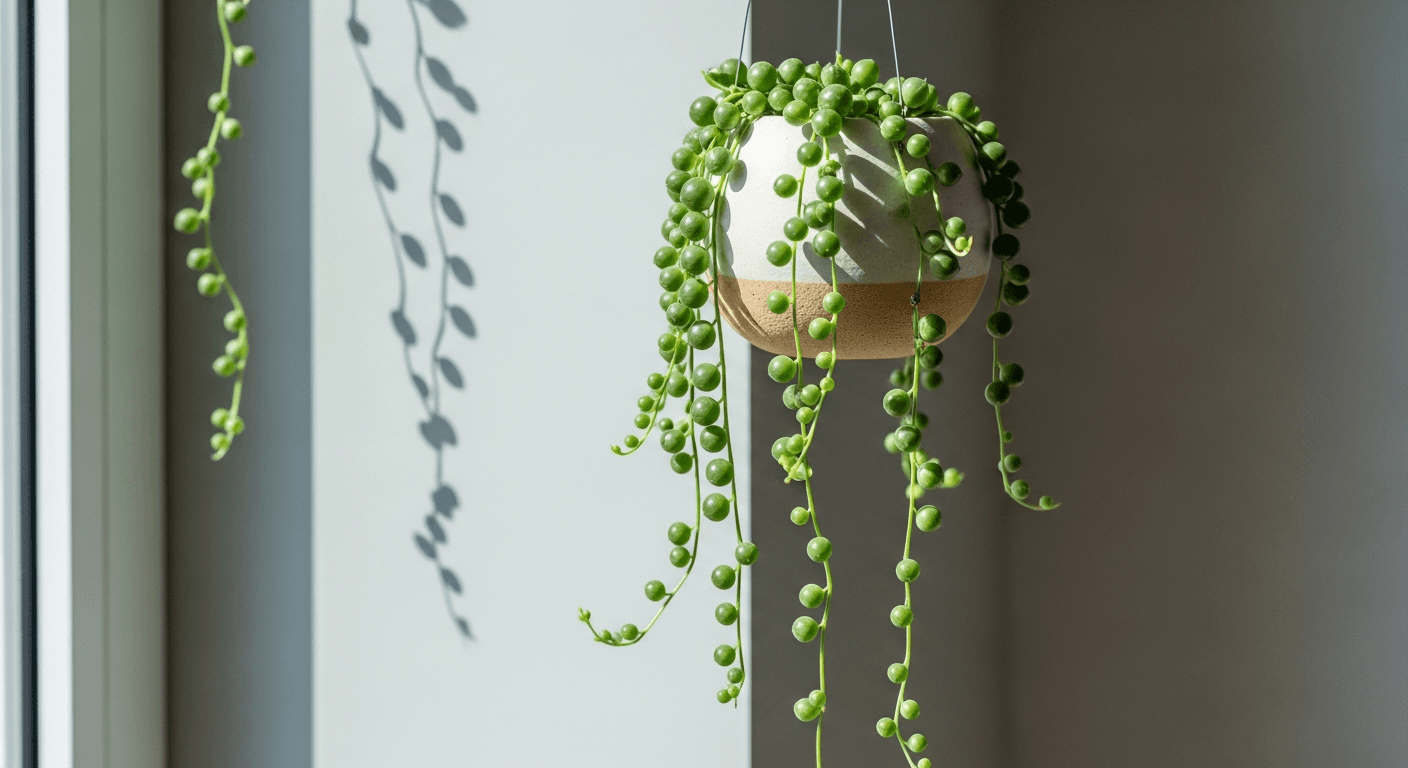
String of pearls (Senecio rowleyanus) is an unmistakable trailing succulent: long stems strung with tiny green spheres like beads on a necklace. It looks stunning in a hanging pot or cascading off a high shelf, but it has a reputation for being fussy. The trick is to remember it's a succulent and treat it like one.
| Care | Need |
|---|---|
| Light | Very bright indirect |
| Watering | Only when soil is dry; sparing |
| Soil | Cactus and succulent, very free-draining |
| Pot | Wide, with drainage holes |
| Toxicity | Toxic to pets and people |
Why its leaves are spheres
Those "pearls" are ball-shaped modified leaves. The round form reduces the surface exposed to the sun and minimizes water loss in its dry South African habitat. Each pearl also has a small translucent stripe (a "window") that lets light reach the inside of the leaf.
Is your plant looking off and you are not sure why?
Free AI diagnosisBasic care, point by point
Light
- Ideal: very bright indirect light, right next to a sunny window.
- Tolerates: a little gentle morning sun.
- Avoid: harsh midday sun through glass, which shrivels and scorches the pearls.
If the stems grow leggy with widely spaced pearls, it needs more light. Move it closer to the window gradually.
Watering: the trickiest part
This is where most string of pearls die. They store water in their spheres, so water only when the soil is dry and the pearls start to look slightly less plump.
- In spring and summer, once every 10-14 days is usually enough.
- In winter, space it out much more, every 3-4 weeks.
- Water thoroughly and let it drain; never leave water in the saucer.
Golden rule: when in doubt, don't water. Overwatering rots the stems almost immediately.
Soil and pot
Use a cactus and succulent mix, or blend regular potting soil with plenty of perlite or coarse sand. The pot must have drainage holes. Terracotta helps because it dries the root ball faster.
Propagation: very easy
It's one of the most rewarding succulents to multiply:
- Cut a healthy stem about 4 inches (10 cm) long.
- Strip the pearls off the last inch (2-3 cm).
- Lay that section on damp soil (you can coil the stem on the surface).
- Keep it lightly moist in bright light; it roots in 2-4 weeks.
For a fuller pot, plant several cuttings together from the start.
Its care and its hanging spot are shared with the string of hearts, which is a bit tougher to start with. Both are succulents, so the fatal mistake is the same one: overwatering and ending up with root rot.
Common problems
- Shriveled, soft pearls: almost always overwatering and the start of rot. Check the stems at soil level.
- Shriveled but firm pearls: underwatering; a drink usually revives them.
- Bare stems at the top: not enough light or prolonged drought.
- Pearls that burst at a touch: too much direct sun.
If you're not sure what's wrong, upload a photo to our AI diagnosis tool and it'll point you toward the most likely cause.
Feeding and repotting
It isn't a hungry plant. During spring and summer, feed once a month with a cactus and succulent fertilizer diluted to half strength. In autumn and winter, stop feeding: the plant slows down and a buildup of salts can damage the roots.
As for repotting, string of pearls has shallow roots and prefers pots that are wider than they are deep. It doesn't need frequent changes; every 2-3 years, or when the soil compacts and holds too much water, move it to a slightly larger pot with fresh, very free-draining soil. Always do it when the soil is dry so you don't damage the fragile roots and stems.
Flowering
In ideal conditions it produces small white, cinnamon-scented flowers in autumn-winter. A cool, dry winter rest encourages it to bloom.
Is it toxic?
Yes. Senecio rowleyanus is toxic to dogs, cats and people if eaten, and its sap can irritate skin. Place it up high, out of reach of pets and children — which also shows off its cascade of pearls beautifully.
In short
Treat it like the succulent it is: lots of light, very well-draining soil and careful watering. Master the watering and the rest takes care of itself. To dig deeper into caring for this group, read our succulents guide.
Related articles
String of Hearts (Ceropegia woodii): Care and Propagation
String of hearts (Ceropegia woodii) care: bright light, semi-succulent watering, soil, super easy propagation and why it gets leggy. Full guide.
Jade Plant (Crassula ovata): Care Guide
How to care for the jade plant (Crassula ovata): lots of light, soak-and-dry watering, succulent soil, easy leaf and stem propagation, and toxicity to pets.
Tradescantia (Wandering Dude): Care Guide
How to care for tradescantia (zebrina, purple heart): bright light for color, watering, pinching to keep it full, super easy propagation, and toxicity.
Trouble with your plant?
AI diagnosis