Pale Patches From the Sun: What to Do With Scorched Leaves
Pale, dry or brown patches from too much direct sun. Learn to recognize leaf sunburn, acclimate your plants gradually, and what to do with scorched leaves.
In this article
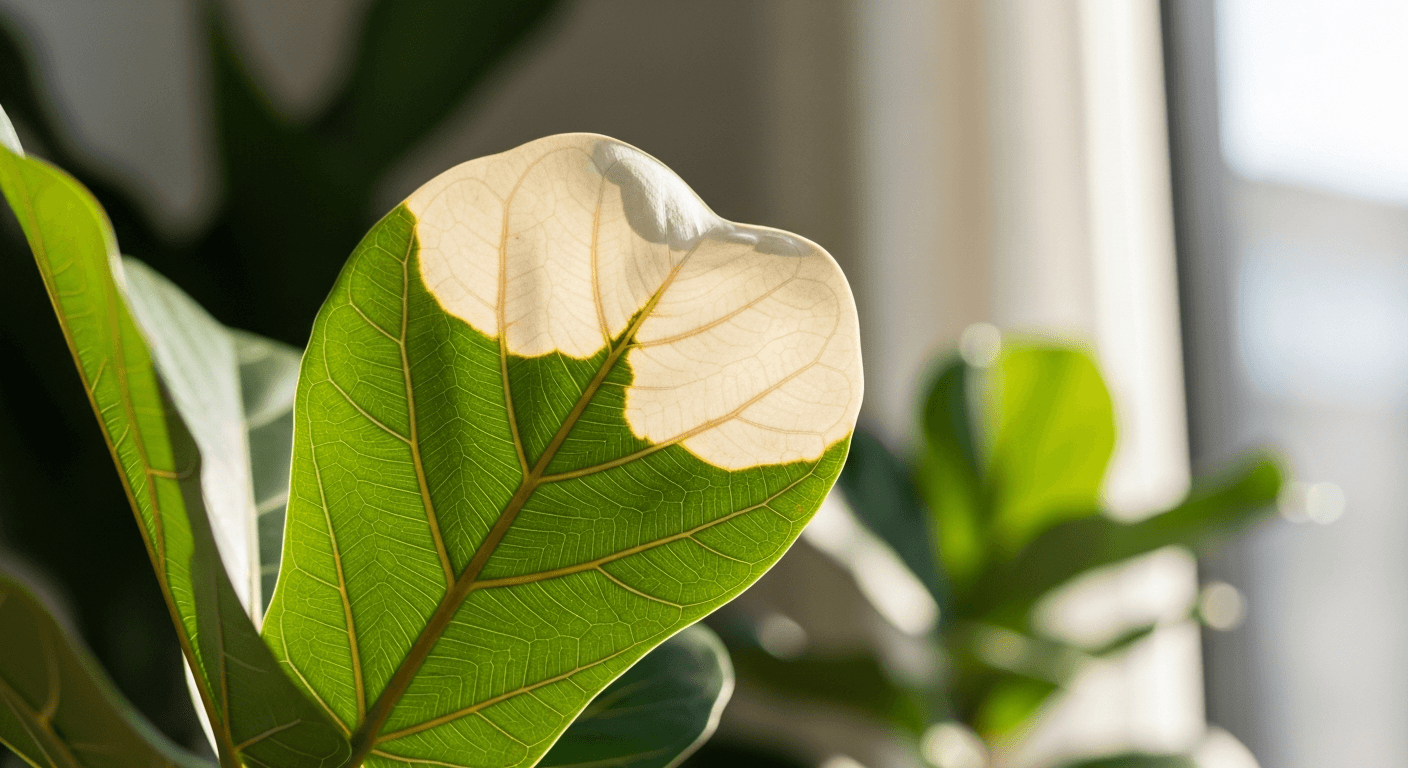
Sun-scorched tissue does not regenerate: that part of the leaf will never be green again. What you can do is move the plant into indirect light and not cut off leaves that still have green areas, because they are still photosynthesising. Scorch is recognisable because it appears suddenly after a move, hits the sun-facing side, and its edge is dry and crispy — never soft, never haloed.
How to spot it and why it happens
What sunburn looks like
Unlike a fungus or a pest, scorch has a very clear pattern:
- Pale, bleached or yellowish patches on the sun-facing side of the leaf, which then turn brown and dry like paper.
- It usually hits the top and outer leaves — the most exposed ones — and leaves the inner, lower leaves untouched.
- The edge of the burned area is dry and crispy, not soft or wet.
- It shows up suddenly after a move or a heatwave, not gradually.
If the spots are soft, dark and have a halo, it's probably not sun but something else: check our brown spots on leaves guide.
Is your plant looking off and you are not sure why?
Free AI diagnosisWhy it happens
Leaves, like our skin, acclimate to the amount of light they get. A plant used to indirect light has leaves that aren't "prepared" for direct sun; hit suddenly by intense radiation, the tissue overheats and dies. The most typical causes:
- Moving an indoor plant outside with no transition.
- Shifting a plant to a south-facing window with midday sun.
- The magnifying-glass effect of water droplets on a leaf in full sun.
- Glass that concentrates summer heat behind the window.
What to do with scorched leaves
Burned tissue does not regenerate: once it's brown, that part of the leaf won't turn green again. Even so, don't rush to cut:
- Move the plant out of direct sun to a spot with bright, indirect light.
- Leave the leaves if they still have green areas; they're still photosynthesizing.
- Trim only the nearly fully dried leaves, or the brown edge if it bothers you cosmetically (with clean scissors).
- Water normally, without waterlogging: a heat-stressed plant doesn't need more water, it needs shade.
How to acclimate a plant to the sun
The key to avoiding this is a gradual transition, especially when moving from indoors to outdoors in spring:
- Start in the shade or with early-morning sun for several days.
- Increase exposure little by little, an extra hour a day over 1-2 weeks.
- Avoid the midday-to-mid-afternoon stretch, the most intense sun.
- During heatwaves, give light shade with a mesh or a thin curtain.
Prevention by plant type
Not all plants tolerate the same thing:
- Shade plants (calatheas, ferns, marantas): never direct sun, only filtered light.
- Bright-light plants (monstera, ficus): tolerate some gentle morning sun, but not midday sun.
- Succulents and cacti: handle lots of sun, but they also burn if they go straight from a dark room to full sun; acclimate them the same way.
To get each plant's spot right, our indoor plant light guide explains how to read the light at each window.
Will the plant recover?
Yes, almost always. Although burned leaves won't turn green again, the plant stays alive and healthy as long as it keeps leaves with green areas and strong roots. Over time it will push out new leaves already adapted to its spot. Be patient: don't move it abruptly again or overfeed it to "speed up" recovery, since that only adds stress. Give it steady light, careful watering and let it bounce back at its own pace. If a bad burn cost it many leaves, keep it in bright indirect light and ease off the watering a little until it puts out new growth.
Summary
Sunburn is irreversible damage but easy to avoid: change locations gradually, dodge midday sun, and don't wet leaves in full sun. Not sure if those pale patches are sun, hard water or a fungus? Upload a photo of the leaf to the AI diagnosis and it'll point you to the most likely cause.
Related articles
Why Your Plant Isn't Growing: 5 Causes and How to Fix Them
Has your plant stopped growing? Discover the 5 most common causes (not enough light, root-bound, winter dormancy, lack of nutrients) and how to diagnose each one.
Brown Spots on Leaves: Causes and Fixes
Brown spots on your plant's leaves? Learn to tell apart fungal, bacterial, overwatering, sunburn and hard-water causes, and how to treat and prevent each.
Succulents: Care So They Don't Stretch or Rot
Succulent care: how much light and water they need, which soil and pot, how to propagate from leaves, and why they stretch. The guide to keep them pretty.
Trouble with your plant?
AI diagnosis